Questions And Answers About Whitewater Rafts
The intent of this section is to explain the purpose of different raft parts and river gear. I am hopeful this will make you better informed and safer on the water, and it might even help you have more fun while whitewater rafting. Before stepping into a boat, many guests find it helpful to review the Ocoee River FAQ to understand the basics of the river itself.
As a veteran guide and ACA-certified instructor, I know that understanding the anatomy of a whitewater raft is the first step toward technical river running. Knowing how tubes, thwarts, and paddles react to hydraulic pressure is crucial—whether you are navigating the Class III waves detailed in the Middle Ocoee Guidebook or facing the high-consequence drops found in the Upper Ocoee Guidebook. This knowledge bridges the gap between being a passive passenger and an active, engaged paddler.
Proper gear usage is also the absolute foundation of river safety. It is vital for every participant to be familiar with swiftwater safety protocols and the inherent risks of the sport. By combining a solid grasp of your equipment with an understanding of Ocoee River Hydrology at benchmark rapids like Broken Nose and Table Saw, you empower yourself to navigate the river with professional-level confidence.
What's a thwart?
Thwarts are the small tubes that run across the raft floor from one external tube to the other. Thwarts help the raft maintain structural integrity, especially in more dynamic water. This helps the raft resist flipping in holes and big water. Soft thwarts can help rafts flip in big water holes like Godzilla and Humongous on the Upper Ocoee's Olympic section.
What's the tube?
The tube is the external flotation of the raft. The tube that runs the perimeter of the raft is made up of multiple chambers. The air pressure of these chambers can be dialed in for the desired characteristics of the raft's handling. Harder rafts tend to flip easier in big holes. Softer rafts tend to create larger pop-ups or possible ejections. It is a trade-off with some pros and cons.
What's the chicken strap?
The chicken strap is the tubular webbing attached to the exterior of the raft by D-rings. The chicken strap's primary purpose is to help crew members re-enter the raft after a swim.
When should I grab or hold the chicken strap?
You grab the chicken strap when swimming and re-entering the raft. You should only grab it when you are not in the raft or if you want to flip the raft to swim with the whole crew. Generally speaking, grabbing the chicken strap while in the raft is bad form and often bad luck.
How do I get back in the raft?
First, swim to the raft and grab the chicken strap with a D-ring between your hands. For best results, it is recommended to have your hands roughly shoulder-width apart or less. While extending your body and feet along the surface and away from the raft, vigorously kick your legs and swim into the raft while using your upper body to clear the tube. Don't let go of the chicken strap until you have cleared the center of mass tipping point. Grab a thwart and finish pulling yourself in.
Don't worry—your raft-mates will help and assist you back in faster. All guides had to do this as part of their training. During the safety talk before your trip, everyone will be taught how to pull someone safely back into the raft. It is very important to participate in your own rescue as well as the rescues of other crew members.
You mean we don't sit on the bottom?
No, you sit on the outside tube next to the thwart. Be careful not to face your back to the outside of the raft, unless of course, you would like to fall out and swim.
How does the raft drain?
The floor is inflated with a pressure relief valve to protect it. There are drain holes along the perimeter of the floor. As the floor rises, water escapes through the drain holes. This system works because air is lighter than water.
What is a PFD?
PFD most often stands for Personal Flotation Device but could also stand for Personal First Descent. Your personal flotation device helps you float as well as providing some degree of impact protection. It is extremely important that your PFD is properly fitted. Guides check to assure proper fit, but some guests will loosen their PFD when the guide is not watching. When these guests fall out, their PFDs occasionally fall off or otherwise do not help them float high enough to breathe well. However, the final test is being hauled back into the raft. An improperly fitted PFD may come off in the process leaving the victim in the water with no PFD.
Why am I required to wear a Helmet?
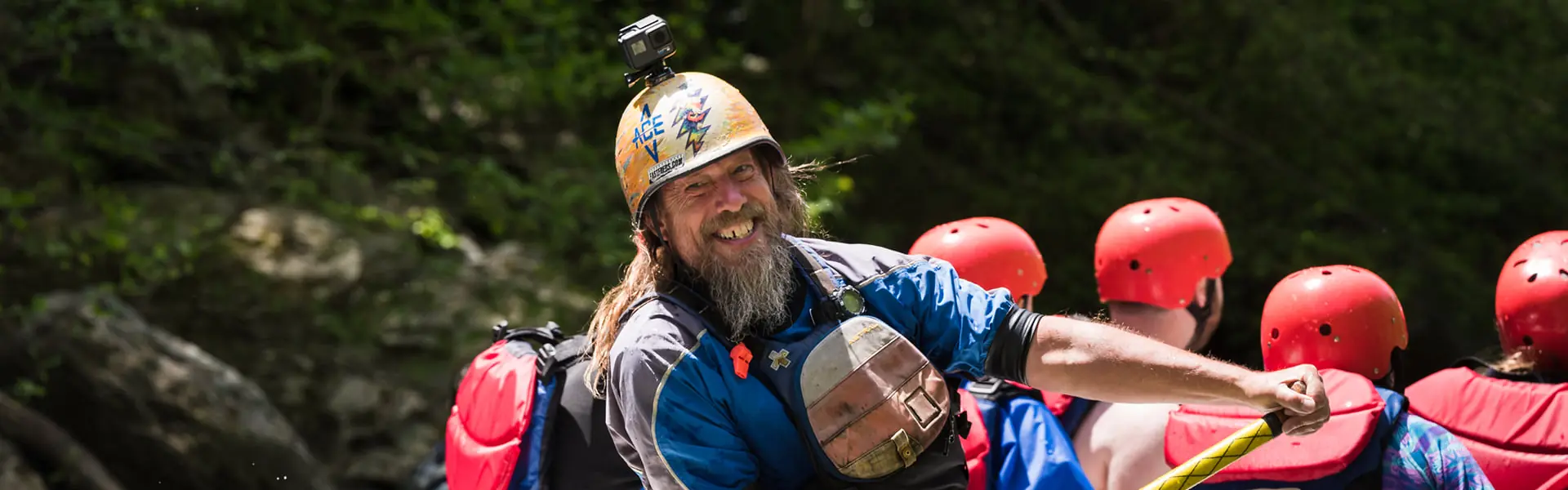
Your helmet helps to protect your head from impacts. Often excited guests let T-grips fly about, injuring themselves or others. The typical helmets used by outfitters are one size fits all. Make sure you follow instructions and properly adjust your helmet. The better you fit your helmet the better your odds of avoiding injury. My outpost also has some helmets with GoPro mounts by request in case you want to video your trip.
Can I adjust my helmet to avoid a tan line?
People are often seen wearing their helmet further back on their head to avoid a tan line. While you might avoid a temporary tan line, you risk a more permanent scar or bruise.
What are the parts of a paddle?
Paddles are made up of three parts: the T-grip, shaft, and blade. The T-grip is the most dangerous. It is important to always hold your T-grip with your hand wrapped around it. You hold the shaft about a shoulder's width from the T-grip with your other hand for best power. The blade should be completely immersed during each stroke.
Why are shoes required?
Rocks in and near the river can be sharp or harmful to feet. Shoes are important to protect your feet. Water shoes, old tennis shoes, and even sports sandals like Chacos and Tevas are acceptable. Some of the river related gear I use can be found at my Amazon shop.
Video: What to Wear Rafting
Learn more about wearing the proper gear to stay comfortable on the river in my video above.